
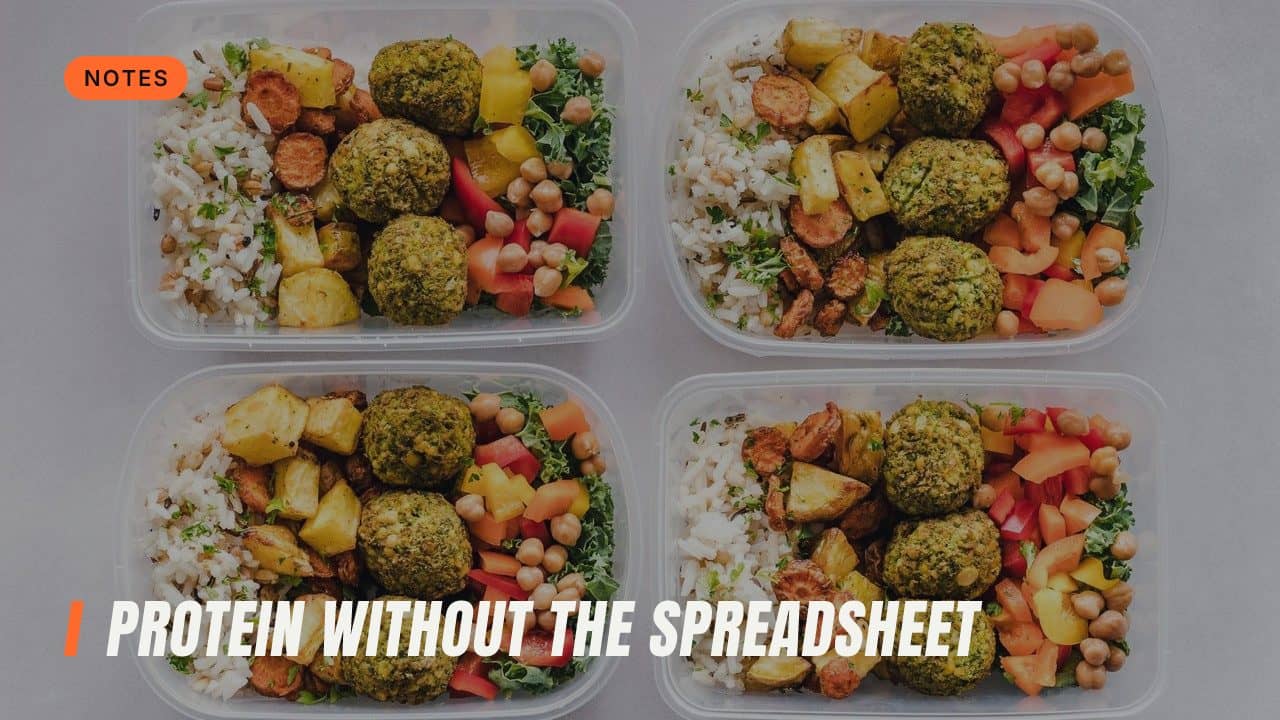
Protein Without the Spreadsheet
Skip the food scale — a simple, hand-based way to get enough protein without tracking every gram.

Contents
Ask five people in a gym how much protein they eat and you'll get five confident, slightly different numbers, usually pulled from an app none of them opened this week. Protein matters — for recovery, for keeping strength while you're in a calorie deficit, for feeling less wrecked the day after a hard strength session — but it doesn't require a spreadsheet to get right. It requires a plate and a habit.
The palm-and-fist method
Skip the gram-counting and start with your hand. A palm-sized portion of protein — chicken, fish, eggs, tofu, a scoop of Greek yogurt — at each meal gets most people most of the way there without a single calculation. Training hard most days? Make it a palm and a half. The point isn't precision, it's consistency: a rough target you'll actually hit three meals a day beats a perfect target you hit twice a week because tracking felt like a chore.
This works because protein needs scale with body size in the first place, and your hand happens to scale with your body too — a convenient shortcut that spares you the app and the kitchen scale.
Spread it out instead of front-loading it
A lot of people eat almost no protein until dinner, then try to make up the gap with one enormous plate. Your body doesn't store protein for later use the way it does fat — it uses what's available for muscle repair in a given window and moves on. Spreading protein across three or four meals gives your body a steady supply to work with all day, instead of one late feast and a long stretch with nothing.
If breakfast is the meal you skip protein on, that's the easiest one to fix. Eggs, yogurt, a protein shake if mornings are rushed — anything beats starting the day at zero.
What actually counts
Eggs, dairy, fish, poultry, and red meat are all straightforward, high-quality sources — no ranking needed between them for most goals.
Beans, lentils, and tofu count too, just in slightly larger portions to hit the same target.
Protein shakes are a convenience tool, not a requirement — useful on a busy day, unnecessary if your meals already cover it.
The best protein target is the one you'll actually hit on a Tuesday, not the one that looks impressive in a spreadsheet on a Sunday.
When it actually matters more
Protein intake matters more than usual in two situations: when you're eating in a calorie deficit and trying to hold onto strength and muscle, and after a heavier-than-usual training block your body needs to recover from. In both cases, the palm-and-fist approach still works — just lean toward the higher end of your range rather than the lower one, and don't skip meals to save calories elsewhere.
Outside of those windows, most people training a few times a week are closer to their protein target than they think. The gap usually isn't a shortage of protein-rich food — it's a habit gap, a breakfast with none, a dinner that's mostly carbs, a snack that could've been yogurt instead of chips.
Start with one meal
If this feels like a lot to rearrange at once, don't. Pick the one meal where your protein is weakest — usually breakfast — and fix that first. Once it's a habit, move to the next one. You'll hit a solid, sustainable protein intake faster by fixing one meal at a time than by trying to overhaul your whole diet against a number you copied from somewhere else.